Procedural Lore: How "Aetheria Online" Writes Dynamic Quests Every Midnight
By pairing local language models with player-action logs, the developers of a fictional online RPG generate fresh quest lines overnight. Here is the architecture — and the human editors in the loop.
Ravi Okafor
Games & XR Editor • • 3 min read
The quick take
- 1Midnight pipelineA nightly job turns anonymized world events into draft quest lines.
- 2Lore bible as guardrailWriters' canon and quest templates keep generated stories on-tone and on-lore.
- 3Humans approveEditors review each batch and reject repetitive or broken quests before release.
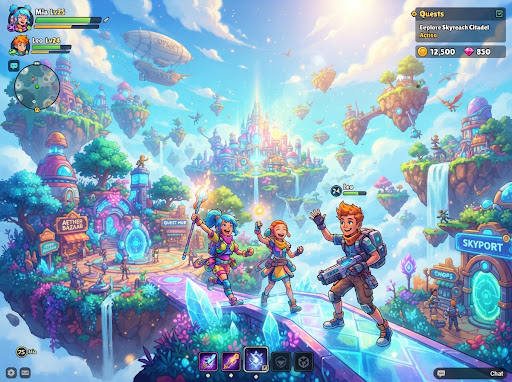
Every night, as the servers of the fictional online RPG Aetheria Online reach midnight, a quiet process begins. Within hours, new quest lines appear for players to discover in the morning. This procedural engine deep dive, set in the illustrative world of developer Brightmoor Games, explains how that pipeline works, where it breaks and why a team of human editors still sits at the center.
The nightly pipeline
The pipeline has four stages. First, a collector summarizes the previous day's world events: which towns were raided, which merchants ran out of stock, which dungeons were cleared. These summaries are anonymized and describe the world, not individual players. Second, a planning step chooses a few story seeds, such as a missing caravan or a feud between guilds. Third, a local language model drafts the quest text, dialogue and objectives using fixed templates. Fourth, an automated validator checks that the quest is actually completable before it moves to review.
"Running models locally on our own hardware keeps costs predictable and keeps player data in-house," says fictional lead designer Wenna Ashcroft. "It also means we can tune the models to our tone."
The lore bible
The most important file in the system is not code. It is the lore bible, a large document that defines the world's history, factions, geography, speech patterns and taboos. Writers maintain it, and the generation step receives relevant excerpts as context for every quest. If the bible says that a certain kingdom never uses fire in religious rites, the generator is told so and a validator looks for violations.
Ashcroft says the bible is the difference between a living world and a pile of plausible text. "Without it, the model drifts. With it, quests feel like they were written by someone who knows Aetheria."
Quest templates
Quests are built from templates, structures like "deliver an item," "investigate a disturbance" or "escort a traveler," each with slots for characters, places and twists. The model fills the slots and writes flavor, but it does not invent new mechanics. This keeps rewards, difficulty and pathing under the control of designers, and it keeps the validator simple.
Human review in the loop
Each morning before the quests go live, a small editorial team reviews the batch. They read for tone, check for sensitive content, and test a sample by playing it. Editors can approve, edit or reject each quest, and rejected quests feed back into the system as examples of what to avoid.
- Tone check. Does the voice match the faction and the region?
- Safety check. Is there anything offensive, confusing or inappropriate for the game's age rating?
- Play check. Can the quest be finished, and is it interesting to finish?
Failure modes
The team is open about what goes wrong. Repetition is the biggest problem: models love familiar story shapes, and players notice when three different villages suffer the same missing-lamb mystery. Brightmoor counters this with a rolling memory of recent quests and a rule that discourages repeating seeds.
Broken quests are the second issue. A model might ask players to talk to a character who has been removed from the world, or to collect an item that does not drop. Automated checks catch most of these, and editors catch the rest. Occasionally something slips through, and the studio keeps a fast patch process for exactly that reason.
Community reaction
Players are divided. Many enjoy the sense that the world is alive and that their actions have consequences. Others miss the handcrafted feel of designed quest chains and worry that generated content could crowd out authored stories. Brightmoor has responded by marking generated quests with a small label and by promising that major story arcs remain written by hand.
"We use the engine for the connective tissue, the small stories that make a world feel inhabited," Ashcroft says. "The big moments are still written by people who care about them."
"Generated content should make a world feel bigger, not cheaper."
Lessons for other studios
For teams considering something similar, the Aetheria approach offers a few lessons. Invest in the lore bible first. Constrain the model with templates. Validate automatically, and review with human eyes. Be honest with players about what is generated. Aetheria Online and Brightmoor Games are fictional, but the architecture reflects practical thinking: procedural tools work best when they extend a team's voice instead of trying to replace it.
Launch edition note: this is an illustrative story. The studios, platforms, people and events are fictional. See our disclosure protocol.
Ravi Okafor
Games & XR Editor at NewsEntertAI. Launch-edition byline. Spotted an error? Tell us.